As the readers of this blog probably know, I have spent a lot of time and effort on identifying the components of our Central Social Districts and analyzing what makes them succeed or fail. I’ve dug deeply into public spaces, movie theaters, housing, and various other components in cities large and small.
Recently, I was asked for one article that put it all together. I realized that I did not have one, so I consequently set out to write it. That article was recently published in The American Downtown Revitalization Review – The ADRR at https://theadrr.com/
Doing the topic justice meant that it would be long, about 30 pages, and more like a monograph than an article. Readers wanting a quicker take can just focus on the first six pages. However, if you are looking for more guidance about what to do and not do, you will need to dig deeper into the article.
Some of the important things I tried to do are to establish that some components are much easier and cheaper to establish than others, and which work better in different types of downtowns. I also tried to strip away a lot of the advocacy hype about some components that too often hides the challenges involved and obscures how progress needs to be evaluated, e.g., the arts venues, while spotlighting venues whose importance still goes widely unrecognized, e.g., libraries.
Here’s the article’s tease and link:
Strong Central Social Districts: The Keys to Vibrant Downtowns
By N. David Milder
DANTH, Inc.
CSDs and Some of Their Frequent Components. Since antiquity, successful communities have had vibrant central meeting places that bring residents together and facilitate their interactions, such as the Greek agoras and the Roman forums. Our downtowns long have had venues that performed these central meeting place functions, e.g., restaurants, bars, churches, parks and public spaces, museums, theaters, arenas, stadiums, multi-unit housing, etc. The public’s reaction to the social distancing sparked by the Covid19 pandemic, and the closure of so many CSD venues, was a natural experiment that demonstrated how much the public needs and wants these venues. They are the types of venues and functions that make our downtowns vibrant, popular and successful. To read more click here : https://theadrr.com/wp-content/uploads/2021/07/Strong-Central-Socia-LDistricts-__-the-Keys-to-Vibrant-Downtowns__-Part-1-FINAL.pdf
We Need More Than Pollyannaish or Wishful Thinking for Our Downtowns to Recover and Thrive
We are in the midst of what many observers have called the deepest crisis this nation has faced in many decades. It has been especially injurious to our downtowns because it has necessitated massive social distancing that makes it impossible for so many downtown entities, — e.g., shops, eateries, offices, movie theaters – to function properly or profitably. In this situation, it is understandable if downtown leaders and stakeholders look for signs that their future will be considerably better. Hope is perhaps the most underestimated, yet essential ingredient of any downtown revitalization or recovery. Still, if our downtowns are to recover, we must face realities and overcome some exceptionally strong challenges, while taking advantage of any new opportunities that this terrible crisis either creates or reveals.
In recent weeks a number of articles have appeared that have been quite pollyannaish about the recovery of our downtowns based on either wishful thinking or sloppy analysis. These puff pieces may be good for instilling hope, and perhaps are even needed. However, they are no substitutes for the kind of critical thinking and contingent planning that we need to start doing now if we are to robustly recover as quickly as possible.
Will Entrepreneurial Gold Dust Really Fall to Spark Our Economic Recovery?
The Wishful Trend. One retail expert has recently written:
“When all the dust settles, the post-lockdown era should provide a boost to downtown areas, in part due to newly unemployed but highly skilled restaurant and retail workers opening new businesses in downtowns where rent prices will trend downward.
The pandemic has left millions of highly skilled workers from the retail and food and beverage industries unemployed and eager to work. Many of these people are highly motivated to start their own businesses, creating an unparalleled pool of talent and potential entrepreneurial interest.
In a recent Forbes article, Bernhard Schroeder wrote: ‘27 million working-age Americans, nearly 14 percent, are starting or running new businesses. And Millennials and Gen-Z are driving higher interest in entrepreneurship as 51 percent of the working population now believes that there are actually good opportunities to start companies.’”1
A Reality Check. However, Schroeder was citing data from the “Global Entrepreneurship Monitor United States Report 2017” published by Babson College in 2018. It must be noted that:
The GEM data are from before the swift and powerful economic decline the Covid19 crisis caused. There is no telling yet of precisely how the crisis has diminished the number of nascent firms or killed off the young firms under 42 months old that the GEM studies look at. A reliable picture of the situation may not be possible until the CARES subventions time out.
Although the 2017 Gem study found that the Wholesale/Retail sector accounted for the highest proportion of the nascent and young firms in the United States, 21% , it had not grown from the previous year and was “dramatically lower than the average of the 23 innovation-driven economies, 31%.”2 Just a year later the Gem study found that the finance, real estate and business services accounted for 27% of the new and nascent firms, while retail, at 26%, still considerably trailed the other high income economies at 36% (see chart below from the 2018 Gem study.) 3
Retail has long been a downtown storefront space use, but in pre-crisis years many downtown leaders were worried about their ability to attract and maintain retail tenants. The Gem study showed that we were not generating as many retail startups as other innovation driven economies. And that was in relatively good economic times.
The fastest growing sectors for entrepreneurship were those that involved technology and knowledge – possibly good for generating office demand , but not exactly the types of firms noted for tenanting lots of downtown storefronts.
The Millennials and Gen-Zers are among the two most economically screwed generations in living memory, so while many of them may have had an interest in entrepreneurship in 2017, even then raising capital for such a venture was probably a frequent barrier to actual entry. Many of them are so strapped for income that they are still living with their parents, and Covid19 has increased their numbers. Raising capital was probably less of a challenge for those with gig or freelance sole proprietorship, but those “firms” also don’t fill many downtown storefronts.
Most importantly, and more precisely, we don’t know how startup rates will be impacted in the sectors that are most likely to produce tenant prospects for downtown storefronts – or which sectors they might be. How the continued growth of online retail sales and their integration into omnichannel operations will play out in terms of the amount, kind and location of physical commercial spaces remains to be seen. While most pamper niche operations have low initial capital costs and relatively low operating costs so they can be reconstituted with comparative ease and speed during a recovery, there is a real question about the availability of the types of consumer discretionary spending dollars they depend on.
Nor do we know how the Covid crisis’s economic impacts will influence current and future levels of interest and intent in becoming an entrepreneur. Most importantly, we don’t know how interest and intent will be impacted in the sectors that are most likely to produce tenant prospects for downtown storefronts. The blue line in the above chart from the 2018 GEM study shows the level of people aged 18-64 who intended to become an entrepreneur within a few months. The path is upward, though it shows much fluctuation, a Great Recession climb, and a bumpy 2016-2018 ride. The red line shows the percentage of the 18-64 population who are either a nascent entrepreneur or owner-manager of a new business, e.g., between 3 and 42 months old. It dived through the start of the Great Recession and then had a mostly upward path since. Obviously, these firms benefited from a recovering economy. Unfortunately, GEM does not provide a sector breakdown. Given that the constructive destruction in the retail industry and serious problems in several parts of the restaurant industry had already appeared, there is reason to suspect that nascent and young firms in those industries were not doing as well as those in other industries.
Recent losses of retail jobs have been huge, and industry reports indicate it will continue to grow through this year, as record numbers of retail stores are closed (perhaps over 20,000), and many chains enter bankruptcy. Are more retail workers, past or present, likely to find appealing startup opportunities in this kind of retail industry than in pre-crisis years? Will other entrepreneurs find the opportunities in the retail sector more potentially rewarding and less risky as those to be found in other sectors?
The attempt to see unemployed retail workers as an asset that will convert into an above average level of new retail startups as we recover may carry with it the implication that unemployment creates a high level of job need to which heightened entrepreneurship is a response. The 2018 GEM study presents data on the number of nascent and young firms (the total TEA) that were “necessity driven (see blue line in chart below). The necessity driven firms over all the years studied steadily account for a relatively small portion of all TEA firms. While the Great Recession did increase their number for some years, overall their number did not change all that much, and never reached levels where they might spearhead startup led downtown recoveries.
B&M retail stores are taking on new functions and that may mean the skill sets of former retail employees are increasingly outdated and provide no advantage for starting up new types of retail and restaurant operations. For example, a new type of department store is appearing, — e.g., Neighborhood Goods, Showfields, b8ta – that sells curated collections of merchandise created by online birthed merchants.4 Also, the growing number of “ghost kitchens” can reduce the relevance of kitchen skills in the restaurant industry.
Restaurants, another major source of downtown tenants, also have been clobbered. Prior to the crisis many parts of this sector, e.g. casual dining, were already showing stress. The current need for social distancing and the apparent current danger of indoor dining, makes it very hard for restaurants to make needed profits. Until models for restaurants operating profitably under these conditions emerge, or the crisis significantly abates, will the sector be able to maintain the interest of entrepreneurs and its skilled workforce?
Here again the competitiveness of the opportunities the restaurant industry offers in terms of potential rewards and risks is very relevant. Restaurants have long had a very high failure rate compared to other industries – and Covid19 has certainly not done anything to diminish that fact. Also, external financing for restaurants has long been relatively hard to get, and their startup costs, if a full kitchen is involved, can be high. Self-financing during a recession and in its recovery years is also likely to be difficult.
Much is being made about the costs of store space. They typically amount to about 10% of the total sales of restaurants and various studies over the years have found that they are between 8% to 12% for most downtown merchants.5 Rents may indeed be important, but these firms have many other costs such as labor, inventory, insurance., etc., to factor in and be concerned about.
The Kauffman Foundation’s 2017 State Report on Early-Stage Entrepreneurship found that “the rate of new entrepreneurs ranged from a low of 0.16 percent in Delaware to a high of 0.47 percent in Wyoming, with a median of 0.30 percent. This considerable geographic variation certainly might also characterize the emergence of new entrepreneurs as we recover economically from the Covid crisis. It certainly suggests that entrepreneurship levels are dependent on a set on conditions, not just the cost of space, and will vary geographically with their strengths and weaknesses.
This is not to say that the recovery will not see either new downtown firms appearing or the full reopening of downtown firms that had suspended their operations. The question is how many of these startups and recovering firms can fill downtown storefronts with well activated and magnetic uses? Will they bring downtown vacancies back to acceptable levels? Will they bring customer traffic back to or above prior levels? Or will they just fill a few vacancies with drab uses that attract weak flows of customer traffic? Right now the difficulty of answering those questions is compounded by the fact that we probably won’t know the full extent and dimensions of our downtown vacancy problems until after the CARES subsidies time out, when the downtown operations then have to support themselves from “normal” type operations.
Is There a Real and Strong Startup Trend That Downtowns Can Ride to Recovery? If one goes back to some Kauffman Foundation studies about entrepreneurship in the decade or so prior to Covid19, one sees that there was not any steady trend of growing entrepreneurship. Indeed, there were ups and downs, with some concerns about it stalling or even seriously declining. 6 Covid19 may be sparking a number of startups in industries that help individuals and firms cope with the crisis, but I have not observed, or heard from professional friends, or seen any published reports that claim it is causing lots of new downtown storefront-filling firms to open. There is no data-proven strong startup trend for downtowns, especially in smaller cities, to ride to their economic recovery.
In sharp contrast, there are loads of data to show that remote work increased enormously in response to the crisis and lots of surveys that show that significant numbers of both workers and employers now think their remote work arrangements will continue on into the post crisis era. These are signs that remote work is a trend that has a good chance of lasting. There are no comparable data signals for resurgent entrepreneurship in the sectors that might occupy downtown storefronts, such as retail and restaurants.
Do We Just Sit on Our Hands? The settling of the crisis’s dust may or may not occur anytime soon. Whether it happens quickly or slowly can be pivotal. As John Maynard Keyes famously wrote “In the long run we are all dead.” The full impacts of other trend breezes such as remote work, changes in commuting patterns, and e-shopping may well take a decade or more to play out. They in turn may have big impacts on the demand for downtown storefront spaces, space uses, and occupancy rates.
What will happen to our downtowns during those years? Should downtown stakeholders and management organizations then just wait for the dust to settle and hope that new startup merchants will appear? If not, then what should/can they do?
Contingent Planning
Since it is far from certain that entrepreneurial gold dust will fall from heaven as the Covid crisis ebbs, perhaps it is valuable for downtown leaders to do some contingent development planning about what they can and will do to cultivate the types of small businesses that can tenant their district’s storefronts. Here, again, the variation in local conditions will probably mean a corresponding variation in responses. And prudence suggests anticipating a process of trials, errors, learning and adapting.
Community Supported Enterprises. For many years prior to the Covid crisis, in downtowns and Main Streets that were suffering storefront vacancies, severely weakened retail, and even food deserts, some local leaders created successful solution paths to these challenges. In our Covid economic recovery period, many other downtowns of all sizes may find these solution paths worthy of consideration. These solutions were most apt to succeed in situations where profitable operations were possible, but investors considered the rewards of entering these downtowns or Main Streets lower and riskier than the opportunities they were being offered elsewhere. Some of these solution paths are:
Using crowdfunding to help open and/or maintain businesses strongly wanted by the local community
Using Community Owned Enterprises to save and operate key commercial operations
Using local social assets, such as social clubs, to leverage business development 7
Towns buying and operating failing essential retail operations, such as groceries.
Using such business models, and any riffs upon them, may help many downtowns and Main Streets recover their vibrancy over the next few years. They may be essential components of a New Deal program to revive retail. For more information about many of these business models see The Spotlight group of articles in the forthcoming Fall Issue of the American Downtown Revitalization Review at https://theadrr.com/ that will appear in September 2020.
Creating Supportive Small Town Entrepreneurial Environments.8 While much attention has been given to the creation of Innovation Districts, this concept is so large scale and complicated that it is only really applicable to big city downtowns and neighborhoods that are present in about 349 of our cities. Our remaining approximately 19,000 incorporated places also need a supportive startup culture and environment, but one that is simpler, less expensive to create and operate, and appropriately aspirant in its growth objectives. That is especially true at a time when many, if not most, downtowns will probably be striving to cultivate their own startups to occupy their storefronts. Such a Small Town Entrepreneurial Environment (STEE) might include: social places for new and small business operators to meet and network; access to viable funding sources; effective technical assistance; joint marketing programs, and affordable spaces in reasonable condition. It basically can take many existing downtown assets, such as libraries, bars, coffeeshops, makers places, community colleges, a downtown organization that invests in businesses and has niche marketing programs, etc., to create an informal district-wide business incubator and accelerator, Libraries in particular, are emerging as critically valuable STEE assets. Unfortunately, most downtown organizations do not yet see being actively engaged in small business development and expansion as a proper role for them to play. Nor do they exhibit any comfort or skills in playing that role when they do. A contingent planning effort could focus on how downtown leaders would foster the emergence of STEEs, should the need for it arise. This will likely entail a reappraisal of the roles the downtown organization should and can play.
Small Merchant Training. The Covid crisis has reinforced the growth of two important nascent merchant trends:
Small and micro firms were weaving increased online activities with the operations of their brick and mortar stores. Customers ordering online and then picking their orders at the curb or at the storefront is one example of this.
More small merchants were tapping customers in distant market areas via their online storefronts and attending distant trade shows and fairs.
A contingent planning effort also could focus on how downtown leaders could encourage and train more of our smaller downtown merchants to use an omnichannel marketing operation that would help them to capture more sales dollars from both local and seldom before penetrated distant markets.
However, even prior to the Covid19 crisis, small merchant training has long been a challenge. In my experience, merchant training programs are often advocated, but seldom effectively implemented. The vast majority of them underperform because they ignore basic merchant needs and behavior patterns. Far too often, they want to EDUCATE the small merchants, and make them, for example, marketing savvy or bookkeepers. That can take a lot of merchant time and effort while providing them with more information than they have any need for near-term or even probably well into the future. Instead, what the merchants want is not to be taken to school, but actual solutions to their specific immediate problems. They want action steps that are credibly viable, affordable and easy to do. They don’t really want courses, workshops, or seminars. And they prefer not leaving their places of business.
Also, in my experience, many small merchants are resistant to any suggestion that they are not doing things as well as they could be done, while others find it hard to ask for help even when they badly need it. Small merchants are often small merchants because of their need for independence and a strong sense of their own efficacy.
Merchant training programs would probably be more effective if they:
Consider small merchants behaviors and attitudes as much as they do the information the program’s experts believe the merchants should learn
Give merchants access to training that is closely tied to their immediate needs, and less into making them better, more knowledgeable entrepreneurs. Blasphemously, feed them fish, don’t try to teach them how to fish. Small merchants play too many roles to be experts in all of them, and they lack the dollars to hire others to take on some of them.
When possible, facilitate merchants learning from their peers whom they know, like and respect. In turn, that means it’s very productive to identify in a downtown those merchants who can be models and mentors for other merchants, and then to leverage them.
Start off by identifying the low lying fruit that can produce the quick wins that will enable the training program to swiftly show other nearby merchants what it might do for them.
Perhaps some of national organizations such as IDA, IEDC, and National Main Street can develop such improved small merchant programs that can then be easily tailored to local conditions. Leaving their development solely to organizations such as SCORE or the SBDCs is a massive mistake. A strong need for such programs existed well before the Covid19 crisis, and will very likely far out last it.
ENDNOTES
1) Robert Gibbs. “After Lockdown, New Opportunities for Downtown Shopping Districts” at https://dirt.asla.org/2020/05/13/the-pandemic-will-lead-to-a-revitalization-of-main-street-retail/ Matthew Wagner wrote an interesting article on the Main Street Blog that also extolled our penchant to be entrepreneurs as a path to recovery, but most of the piece usefully went into the need for various things that I would associate with creating what I called above a STEE. See: Matthew Wagner,” Main Street America. Main Spotlight: COVID-19 Likely to Result in Increased Entrepreneurship Rates” June 9, 2020. https://www.mainstreet.org/blogs/national-main-street-center/2020/06/09/covid-19-likely-to-result-in-increased-entrepreneu
2) Julian E. Lange, Abdul Ali, Candida G. Brush, Andrew C. Corbett, Donna J. Kelley, Phillip H. Kim, and Mahdi Majbouri. “Global Entrepreneurship Monitor United States Report 2017” published by Babson College in 2018, p. 27. https://www.gemconsortium.org/economy-profiles/united-states
3) See: Julian E. Lange, Candida G. Brush, Andrew C. Corbett, Donna J. Kelley, Phillip H. Kim, Mahdi Majbouri, and Siddharth Vedula Global Entrepreneurship Monitor United States Report 2018” published by Babson College in 2019 https://www.gemconsortium.org/economy-profiles/united-states
4) I want to thank Mike Berne for bringing these stores to my attention.
5) See for example: Kate Paape and Bill Ryan, University of Wisconsin-Madison/Extension Division, and Errin Welty, Wisconsin Economic Development Corporation. “A Comparison of Rental Rates Charged for Downtown Commercial Space: A Market Snapshot of Wisconsin Communities”. August 2019 https://economicdevelopment.extension.wisc.edu/files/2019/10/Downtown-Rent-Study-100119.pdf
6) See: “Victor Hwang Testimony Before U.S. House Committee on Small Business, Subcommittee on Economic Growth, Tax and Capital Access,” February 15, 2017
Contact: N. David Milder, Editor The ADRR — The American Downtown Revitalization Review 718-805-9507 [email protected]
THE CREATION OF THE AMERICAN DOWNTOWN REVITALIZATION REVIEW (THE ADRR)
There currently is no real professional journal for the downtown revitalization field. For many years, that has been strongly lamented by many of the field’s best thinkers. To remedy that situation, a band of accomplished downtown revitalization professionals are creating The ADRR. It will be a free online publication, appearing four times each year. The target date for the debut issue is now set for the June 1-15, 2020 timeframe, with the second issue aimed for the Sept 7-14, 2020 timeframe.
This ADRR is intended to be a lean and mean operation, based totally on the availability of free online resources and the time, energy and elan contributed by its authors, advisory and editorial board members, and its editor.
How to Subscribe to The ADRR
Those interested can now visit The ADRR’s website, www.theadrr.com , where, on the home page, they can sign up to become subscribers. This enrollment places the subscriber on a MailChimp mailing list so that they can receive New Issue Alerts (see below).
How Issues of The ADRR Will Be Distributed.
New Issue Alerts, containing the Tables of Contents of issues and links to their downloadable pdfs of articles are sent to subscribers via a MailChimp email blast and posted to the ADRR’s website. Each issue’s pdf files initially will be stored in a folder in ND Milder’s Dropbox account from which they can be downloaded. Subscribers can download only those articles they want to read and whenever they want to read them. The ADRR also can be found via Google searches.
The Content We Are Aiming For. Only manuscripts about major downtown needs, issues and trends will be considered for publication. They will be thought pieces and not just reports about a downtown’s programs and policies that its leaders want to brag about. Articles must have broad salience and their recommendations broad applicability within the field. The “voice” of The ADRR will be anti-puff, and very factual, evidence driven, though not dully academic. Discussions of problems and failures will be considered as relevant as success stories if, as so often is the case, something substantial can be learned from them. The ADRR will not avoid controversial issues.
Also, the focus of The ADRR will not be overwhelmingly on our largest most urban downtowns, but also provide a lot of content and relevant assistance to those in our small and medium sized communities, be they in suburban or rural areas.
Who Will Write the Articles?
Hopefully, they will be from people in a broad range of occupations – downtown managers and leaders, municipal officials, academics, developers, landlords, businesspeople, consultants, etc. — who have significant downtown related knowledge and experience.
Curated Articles and Wildflowers. Initially, the ADRR will solicit articles to prime the content pump. Once The ADRR is up and running some articles will continue to be solicited on topics deemed a high priority by the editorial board members. Each board member can select a topic to curate an article on and seek the author(s) to write them. However, there still will be a continual traditional general call for submissions (wildflowers) focused on subjects selected by their authors. All submissions, curated or wildflower, must demonstrate sufficient merit to warrant publication in The ADRR. All submitted articles will be reviewed by board members. We hope to see many submissions!
Article Length and Author Responsibilities.
There will be short reads and long reads. Articles of 1,500 to 5,000 words will be considered. Multi-part articles of exceptional merit and salience will also be considered. What counts is their quality, not their length. Authors must have their articles thoroughly proofread prior to submission. Poorly proofed manuscripts will be rejected. Guidelines for submissions may be found on The ADRR website.
Publication Schedule:
Published four times per year, with a minimum of 5 articles in each issue. Given that this is an online publication, from a production perspective, the number and length of the articles is not a particular problem. However, from an editorial and content management perspective, the number of articles and their lengths can quickly become burdensome.
How It Will Be Organized.
The ADRR will be published by an informal group for its first year, with no person or group having ownership.
Editor. During the ADRR’s first year, N. David Milder has volunteered to serve as its editor.
The Advisory/Editorial Board :
Jerome Barth, Fifth Avenue Association
Michael J Berne, MJB Consulting
Laurel Brown, UpIncoming Ventures
Katherine Correll, Downtown Colorado, Inc.
Dave Feehan, Civitas Consulting
Bob Goldsmith, Downtown NJ, and Greenbaum Rowe
Stephen Goldsmith, Center for the Living City
Nicholas Kalogeresis, The Lakota Group
Kris Larson, Hollywood Property Owners Alliance.
Paul R. Levy, Center City District, Philadelphia
Beth Anne Macdonald, Commercial District Services
Andrew M. Manshel, author
N. David Milder, DANTH, Inc
John Shapiro, Pratt Institute
Norman Walzer, Northern Illinois University
Articles in our first issue that will be published in June 2020
Michael Berne, MJB Consulting, Working Title, ” Bringing Downtown Retail Back After COVID-19”
Roberta Brandes Gratz, “Malls of Culture.”
Andrew M. Manshel, “Is ED Really a Problem?”
N. David Milder, DANTH, Inc., “Developing a New Approach to Downtown Market Research Projects – Part 1.”
Aaron M. Renn, Heartland Intelligence, “Bus vs. Light Rail.”
Michael Stumpf, Place Dynamics, “Using Cellphone Data to Identify Downtown User Sheds”.
The Spotlight: “Keeping Our Small Merchants Open Through the COVID-19 Crisis”
Katherine Correll, Downtown Colorado, Inc.
David Feehan, Civitas Consulting
Isaac Kremer, Metuchen Downtown Alliance
Errin Welty, Wisconsin Economic Development Corporation.
A few weeks ago, an article appeared in the Congress for
the New Urbanism’s ( CNU) online journal Public
Square titled “Why downtown retail is coming back ” (1). While the article had some valid and
encouraging points, overall it blurred over a very complex situation in which
retail in different types of downtowns
have different prospects for retail rejuvenation and growth. Most importantly,
there was no discussion of the enormous process of creative destruction that
the retail industry is experiencing, one that promises to continue for many
years to come, and that will strongly structure any rebound. Until we get a
better handle on what the new retail industry will look like we cannot get a
good notion about what the demand for retail locations and spaces will be.
Along that line of thought, the article also ignored the facts that any
comeback must be limited when the demand for retail space by national chains
has had a precipitous decline and 45% of the nation’s household GAFO (general
merchandise, apparel, furniture
and home furnishings, other miscellaneous retail) expenditures
are now being captured by online retailers.
The Public Square article makes much about increased retailer interest in “inner cities,” but this trend is anything but new. Major retailers have long been interested in and placed their stores in some types of dense urban locations. For example, by 1985, a ULI study was reporting a resurgence in downtown retailing propelled by growing CBD employment, an increasing appreciation of urban lifestyles, and a dramatic decline in the number of easy suburban retail project opportunities (2). They even have been going into highly ethnic downtowns since the late 1990s and early 2000s as evidenced by their presence in the outer borough downtowns of Jamaica Center, Fordham Road and Downtown Brooklyn in NYC. The article also failed to note that a whole lot of the major retail that is going into our inner cities is not going into their downtowns, but into large self-contained, car-oriented shopping centers that compete with the downtowns.
This raises two critical questions regarding the inner cities that
are very hard to now answer:
When the overall future demand for
retail space is very likely to be far lower than in the past, will inner city
locations really be getting substantially more retail stores located in them?
How many of those new inner city
retail stores will be locating in the inner city downtowns?
As for the retail chains, we know from past experience, their expressed interest
in locations often is not a good indicator
of where their stores will open.
The article also failed to note that most of our downtowns are in
small communities that always had few if any national chains– and that is unlikely
to change in the future. Nor did it discuss the prospects of the small
independent retailers these small downtowns must rely on.
Yes, it can be argued that new stores are opening, and downtown
retailing will not disappear. However,
since it is undergoing very significant changes in magnitude and operational
characteristics, it is still far too early to make any real sense of claims
that it is coming back.
UNDERSTANDING THE CREATIVE DESTRUCTION OF THE RETAIL
INDUSTRY UNLEASED BY THE GREAT RECESSION
What
we have been witnessing in the retail industry is not the oft mentioned retail
apocalypse, but a classic example, at the level of a whole industry, of what
Joseph Schumpeter called the process of
creative destruction — the “process of industrial mutation that
incessantly revolutionizes the economic structure from within, incessantly
destroying the old one, incessantly creating a new one.” While the media,
in its reporting on the retail apocalypse, has focused its attention on the
destruction, far less attention has been paid to the creation of a new,
vibrant and stronger retail industry, but one that may well require far fewer
and smaller brick and mortar retail spaces. That would mean far fewer and
smaller retail tenants for our downtowns.
The
Industry’s Latent Problems. Prior to the Great Recession, the retail industry was largely
ignorant of the truly bad shape it was in:
As Elizabeth Warren’s book, The Two Income Trap, showed several years before the Great Recession, many middle income households were being financially squeezed by stagnant income growth and quickly rising costs for housing, healthcare, childcare, transportation, and education. Their retail spending was often sustained by home-based loans and/or racking up large credit card debt. The Great Recession turned these households into today’s deliberate consumers who are more cautious about their spending, much more value oriented, and demanding of bargain prices. Gone are the middle income shoppers who “traded up” prior to the Great Recession.
In 2009, a team at McKinsey predicted that by 2011, the internet would be involved – i.e., play some role – in 45% of all retail purchases made in the USA (3). The vast majority of the retail chains seemed ignorant of that already well established trend and did not have very robust online presences, much less viable omnichannel marketing strategies. The shock and hurt the Great Recession threw at so many retail chains, the resulting consumer search for value, low prices and convenience, and the emergence of the “to the internet born” millennials, all led to a growing participation in internet shopping.
Far too many of the retail chains were very badly managed and, of course, their leaders never owned up to that fact. Forever 21’s recent going into Chapter 11 is a classic example of this, see https://www.nytimes.com/2019/09/29/business/forever-21-bankruptcy.html . Unfortunately, too many observers of the industry did not either. The problems proved to be myriad. Worst of all were ill conceived growth strategies based simply on opening more stores. Abetting that problem was a surprising ineptitude in decision-making about where to open new stores, how large they should be, and how close they should be to a chain’s other stores. Too often locational decisions were made not by rigorous analysis, but by following where other retailers were locating, especially their favored co-tenants. The old axiom that retail chains are like sheep — they like to herd — was all too true. The net result was that the chains had too many stores that were also probably too large, and too often in less than desirable locations. Many chains were also burdened by carrying too much debt, especially when they were bought out by financial firms seeking to maximize how much money that could extract from the retail operations. These new managers were not merchants, but MBAs trained in financial manipulations. The large debt burdens caused many bankruptcies. In search of profits, corporate managers cut the size and quality of their in-store sales forces, thus substantially diminishing customer service. Then, too, many chains lost contact with their customers by failing to provide the entertaining ambience, convenience, customer service, sizing and merchandise they wanted. Some chains even failed to notice that their customer base was aging out or moving on.
Chain managers began to look more at the value
of the real estate they owned or leased than increasing the profits from retail
sales. Hudson Bay, for example, closed the Lord & Taylor mother store on
Fifth Avenue in Manhattan not because it was losing money, but because of how
much money selling it could generate. This trend continues.
Across the nation, in the years before 2009,
especially in many of our most successful downtowns, be they in big cities or
affluent suburban or tourist communities, many properties with retail spaces in
them were bought for very high bubble-like prices. That meant that retail rents
would have to increase substantially. Moreover, the financing of these deals
often meant that the retail spaces contractually had to be rented to credit
worthy retail chains. When the Great Recession severely struck the retail
industry, these properties and their ability to attract retail tenants were
placed in a very precarious position. The purchase of the “Devil’s Building” at
666 Fifth Avenue in Manhattan was a prime example, but there were so many
others.
While
one can be hopeful that today’s retail chains and those of tomorrow will be far
better managed than those of the past few decades, their past performance
warrants some skepticism about their future behavior. Prudence also suggests
that we can expect them to continue to make many serious errors, especially when
subjected to the very strong pressures created in a process of creative
destruction.
The
Substantially Weakened Demand for Brick and Mortar Retail Locations and Spaces. The Great
Recession brought these problems to a boil and resulted in many well-known
retail chains going out of business, while many others are still fighting to
stay open.
Countless thousands of chain stores have
closed since 2009 – for example, 7,000+ in 2017 and 7,000+ again in the first half of 2019.
GAFO retailers were hardest hit, especially
department stores and specialty apparel chains.
The surviving chains are looking for fewer new
locations, are being far more selective about locations when they do so, and
their new stores are about 25% smaller than those the chains opened in the
past.
There are about 1,350 enclosed malls in the
U.S., but experts believe that only 200 to 400 are needed (4). Most class “B” and “C” malls are doomed to
closure and reuse.
Also, many malls and open air shopping
centers, to stay popular and solvent, are converting retail spaces to other
uses such as entertainment, personal services, food and drink. Some malls are
even adding housing and hotels. According to Costar, between Q1 of 2010 and Q1
of 2019, malls added about 13.9 million SF of entertainment space while open
air centers added about 52.8 million SF of entertainment space (5). Most likely
these additions were done by repurposing prior retail spaces.
There is little reason to believe that similar
trends are not also occurring in a large proportion of our downtowns. For
example, over the past decade, I’ve seen large amounts of former retail space
being leased to pamper niche – hair and
nail salons, spas, gyms, martial arts studios, yoga and Pilates studios, etc. –
and health care operations in downtowns across NY and NJ.
There has also been “vacancy rate creep.” Back
in the 1980s, a rate above 5% signaled cause for some concern and 10% a
problem. Today, a 10% vacancy rate seems to have become accepted as the new OK normal.
A recent 2019 report by Morgan Stanley found
that while “…e-commerce penetration reached 11% of total retail sales at the
end of 2018” that “e-commerce penetration in the GAFO segment” was
now over 45% (6). GAFO retailers are often the ones downtown leaders most want
to recruit.
This huge
capture rate achieved by online merchants plainly indicates that there will be
substantially less need for GAFO brick and mortar spaces. Will rebounding
downtowns, especially those in our inner cities, really be winning the lion’s
share of this reduced demand?
The
Small Merchant Problem. According to Statista: “There were 19,495 incorporated places registered
in the United States in 2018. About 84%, 16,411 of them, had a population under
10,000.” In contrast, only 10 cities had a population of one million or
more and only 310, or about 1.5%, had a population over 100,000 (7). For the
vast majority of these incorporated places, small independent merchants will be
their most likely retail tenants and tenant prospects. Many of these downtowns
have never had a retail chain, while others were able to attract some non-GAFO
chains and, more recently, dollar stores.
As
can be seen in the table above, the very small merchants, those with 0 to 9
employees had the lowest decline in numbers, -7%, between 2007 and 2012, a strong indication
that they were among the least hurt by the Great Recession, though there was
considerable variation by state. Among them was a huge number of nonemployer
firms. Many of them may have stayed open because the owner also had another
job. Among the small merchants, those with 10 to 19 employees probably account for
many of these small towns’ strongest
retailers. They suffered a significantly
higher decline, -15%, a sign they were hurt more by the Great Recession. They
may have been more vulnerable because they were more likely to have had
outstanding loans.
The
vicissitudes these small merchants have faced were quite different than those
faced by the national chains. For one thing, since most of them were not
offering GAFO merchandise, they were less apt to be hurt by the growth of
internet sales. In the years prior to the Great Recession, any small GAFO retailers were likely to have felt
the brunt of competition from big box stores such as Walmart and Home Depot.
Instead, most small town retail businesses were mainly focused on local,
neighborhood type needs such as food and beverages, health and beauty products,
and arts related products. However, in many smaller and less affluent
downtowns, dollar stores appeared and won substantial market share – even from
Walmart.
Small
town primary trade areas are likely to be small geographically and sparsely
populated. If they have under 15,000 people that is too small to support most
independent small GAFO retailers – unless they adopt an omnichannel strategy that also produces
revenue flows from online sales and offsite sales in distant market areas.
A
major challenge for these very small
merchants is the level of local consumer spending, since it directly impacts
the cash flow they are so dependent on. Those in communities where household incomes are hardest hit
will feel the pain most. Those in communities where income and population
growth are stagnant will likewise probably work hard just to tread water. Retailers in small communities with strong household
incomes are more likely to prosper.
Other
major challenges for these small merchants are their skill sets and abilities
to start and maintain a successful business.
By definition, half can be expected to have below average skill sets. According
to BLS data from 2016, about 56.1% of retail startups fail within their first
five years. That means that the smaller downtowns towns dependent on small
merchants can likely expect significant churn with the resulting need to either
recruit or develop new retailers. A possible confounding problem is that
nationally the number of startup firms seems to be diminishing, having fallen
by 19% between 2007 and the first half of 2019 (8). How much this holds true
for small retailers is not now apparent, but if the number of small retail
startups has diminished, that could have important implications for many
smaller downtowns.
The
Green Shoots of the New Retail. On the other hand, there are many signs that brick and mortar
retail will not be completely disappearing, though how many locations and
how much physical space will be required are not now known. Here are some
of the positive signs:
Most Americans still prefer to shop in brick
and mortar stores — 64% according to a
2016 Pew Research Center national survey; 78% also said it’s important to be
able to try a product out in person (9). Several other surveys have over the
years had similar findings. The problem has been that the types of stores
retailers have offered shoppers have not been what many of them wanted! That is
beginning to change. There has been a big increase in retail chain concerns
about better instore experiences and more convenient transactions (purchasing
and deliveries).
Some chains have continued to do well through
these apocalyptic times – off-pricers such as TJ Maxx; dollar stores; grocery store chains such as
Wegmans, Kroger and Aldi, and beauty product stores such as Sephora and Ulta.
Many “old” retailers seem to be learning new
tricks. For example: Best Buy and Target have made notable comebacks; Walmart
has created an impressive internet operation; Kohl’s is experimenting with
smaller stores, bringing in Amazon returns,
and putting Aldi groceries inside its stores, and Chico’s has reportedly found new online
marketing legs.
More retailers are realizing the importance of
customer relationships and how convenience and instore experience can help
build them.
While chain stores have been closing, they
also have been opening, if at a lower rate. Old Navy, for example, plans to
double its store count and penetrate smaller communities.
Internet birthed retailers are opening brick
and mortar stores. They need them to be profitable! It remains to be seen how
many stores they will open. Many of them reduce their space needs and costs by
not keeping merchandise inventories onsite. Many of them like affluent downtown
and neighborhood shopping district locations.
Most importantly, retailers are now avidly
adopting omnichannel marketing strategies that see both brick and mortar stores
and their internet assets as related
ways of connecting to their customers — and often on the same transaction. For
example, it is becoming increasingly popular for shoppers to make a purchase on
a retailers website and then pick it up at the retailer’s nearby physical
store. Retailers are finding that physical stores can stimulate visits to their
websites and conversely that websites can stimulate visits and sales in their
brick and mortar stores.
Retailers are increasingly finding that besides
making sales, physical stores can play many other valuable roles related to
interfacing with shoppers, e.g., being places to pick up purchases,
experience/try out merchandise or
receive pampering amounts of customer service. Their annual sales consequently
may be a poor indication of their true value to the retail chain – or to the
landlords of their leased retail spaces.
Experimentation with smaller stores has been
going on for many years now. Walmart famously tried to do so in some rural
areas, and retreated. Now, a number of other chains are trying out smaller
stores that allow them to enter dense urban markets where their larger formats
cannot fit and/or would create traffic and/or political problems. Target has
been the most visible. The argument can be made that this is an extremely
important experiment for downtown retail growth. If the chains can learn
how to do the smaller formats successfully more will fit not only into dense urban
downtowns, but also into suburban and some rural downtowns. The key to their success
may be how they use the internet and AI
or AR to augment the smaller selections of merchandise they can offer in the
smaller spaces.
As I have noted in an article in the IEDC’s
Economic Development Journal, there is a definite trend in some rural and
suburban communities for new residents, drawn by the area’s quality of life
assets, to open new retail shops (10). In several instances, these shops and
eateries have become some of the best in the downtown. Quite often, those QofL
retailers have been facilitated by the market shares yielded by the department
stores and specialty retail chains that closed in failing nearby malls. It
should be remembered however, that many of these closing retail operations had
well below average market shares – that’s why they failed – and what they gave
up was also prone to being captured to varying degrees by the remaining retail
chains and online merchants.
LOOKING
AT SOME DIFFERENT TYPES OF DOWNTOWNS
Trying
to present a full typology of downtowns would require an arduous and
complicated effort that would likely
divert attention from the main subject of this article. Additionally, just
looking at a few examples will amply serve the purpose of demonstrating different
retail outcomes.
Urban
Downtowns and Commercial Districts. One well-known retail expert was quoted in the Public Square
article as arguing that : “Retailers have saturated the suburbs and the next
underserved market is the inner cities. And they are also thinking that it will
be a trend and growth market.” I found that use of the term inner city somewhat
confounding since I have heard it used overwhelmingly to refer to the core poor
parts of a large city that are usually heavily populated by “minority” groups,
while I think the expert was really using it as a broader synonym for “dense
urban areas”. Within dense urban areas
several different types of retail districts can be found if categorized just by number of stores and shopper affluence –
there is not just one type of inner city retail, district. Here again, to
maintain some brevity, I will focus on a select few. I will look at Manhattan and other NYC retail districts simply
because of the ease of finding relevant
data because of my past research on them.
The Crème de la Crème. This is undeniable: in our major cities, for countless decades there have been major CBD retail corridors that have attracted hordes of trophy retailers– e.g., Fifth Avenue and Madison Avenue in NYC, Newberry and Boylston Streets in Boston; North Michigan Avenue in Chicago ; Rodeo Drive in Beverly Hills, and Walnut Street in Philadelphia. The retail chains show how much they value such locations by not only being there, but by how much they pay to be there. For example, retail rents on the prime part of Fifth Avenue in Manhattan run about $2,871 PSF and about $960 PSF on Madison Avenue – see table above. The retailers often are there as much for the marketing opportunities provided by a “flagship store” as for the actual sales they make. That said, those sales can be huge. Back in 2009, the Apple store on Fifth Avenue reportedly had sales of $350 million, or about $35,000 PSF! Nearby Tiffany reportedly did about $18,000 PSF. (I’ve tried unsuccessfully to confirm these stats. I do not doubt that the sales PSF are very high, but they being that high, I am not sure.)
The
table above is from a report by Cushman & Wakefield on 11 of Manhattan’s
major retail submarkets. Unsurprisingly, Manhattan has tons of retail because
it has a large, affluent population, hordes of people working there and loads
of tourists, especially from abroad, who spend lots of money in retail shops.
The lowest retail asking rent is in the
table is $243 PSF and the average is
$860. It is reasonable to assume that most of the retailers paying such rents
were doing so because they expected commensurate sales revenues and profits. This
shows another basic and perhaps mundane point about our retail chains –they
have long entered urban commercial districts and been prepared to pay very high
rents when they saw a lot of affluent people living, working, playing and
spending in them. The question about retail interest in dense urban
areas has really been about their willingness to enter less affluent inner city
areas.
However, even these affluent submarket areas can have their problems. The Cushman & Wakefield data also show that across these 11 strong submarkets, about 21% of the commercial space is “available”, i.e. vacant or up for lease. In turn, that level of availability suggests that in these strong urban submarkets, something is not quite right. It very probably has little to do with their addressable consumer markets. Most of those consumers have benefited from income inequality, not been hurt by it. More likely are problems associated with the involved real estate properties and their tenants. Some proof of this is that when asked rents have been lowered, the availability rates also went down. There also is a real possibility that there is just too much retail space on the market, even in these posh market areas. It will be very interesting, for example, to see what happens in the 34th Street district after all the new retail space built by Related and Brookfield in and near Hudson Yards is fully activated. Also, greater retail chain entry into urban districts will depend on a lot more than just their desire to do so. It will also depend on local landlords and, as Walmart and Target have learned, the approval of city politicians. Surely, NYC is not the only big city facing such issues. Many of these major city downtowns, for example, have seen the closing or down-sizing of their department stores.
Some of the retailers on Austin Street in Forest Hills, NY
Long Successful Densely Populated Urban Districts. Here in the Borough of Queens, there are two shopping areas that demonstrate that retail chains also have long known about, located in, and succeeded in dense non CBD urban market areas with high expenditure potentials. They are also interesting because they have quite different operational characteristics and customer bases that exemplify what is happening in many of our non-crème de la crème urban commercial districts. Austin Street is a narrow two-lane street that runs parallel to the six- lane Queens Boulevard one block to its north. For about 100 years it has been the shopping area for Forest Hills Gardens and Forest Hills. Since about 1980, it has attracted upper middle income shoppers from an even wider area as such retailers as Gap, Gap for Kids, Banana Republic, Ann Taylor, Benneton, Loft, Nine West, Barnes & Noble, Victoria’s Secret, Aldo and Eddie Bauer decided to locate there– see photos above. Over the years, it has had its ups and downs usually in sync with the general economy. Recently, the B&N closed and one of Target’s “small stores” took its place, and Banana Republic and Ann Taylor have converted to “outlet/ factory” formats. In recent years, more national chains have closed than opened, with retail spaces being replaced mainly by eateries such as Shake Shack, Bare Burger, and high quality Asian restaurants, and personal services such as non-appointment doctors offices and barber shops.
There
are few large commercial spaces on this traditional street, the largest being
the one Target occupies that has about 25,000 SF. Attempts to redevelop
this area to create much larger retail spaces would almost certainly create
a political storm and likely be defeated. If retail chains are to increase
their numbers on Austin Street it will likely be by those able to use value
oriented formats that do not require large spaces, such as the current Ann
Taylor and Banana Republic factory stores. There is no existing space for
another retailer of Target’s size, or a small Whole Foods or a small
Kohls.
Today,
the storefronts constitute a traditional solid line of commercial activity on
both sides of the street for about 0.6 miles. It has a nice scale. It is
walkable, though its relatively narrow sidewalks can quickly seem crowded on
weekends. It can be accessed via four subway lines, the LIRR and several bus
lines, with most shoppers walking or busing there. Parking there is tight both
on-street and off, and not cheap. Some
of its independent retailers have been there for decades. It has some attractive eateries and bars. The
whole package is very much like a successful, walkable suburban downtown and it
attracts some of the borough’s more affluent shoppers who appreciate a non-mall
experience. The core neighborhoods Austin Street serves – Forest Hills
Gardens, Forest Hills and Kew Gardens – were early planned suburbs of Manhattan
and today they maintain many suburban characteristics.
The Austin Street district’s zip code area has 68,733 residents, 61% of whom are white only. The average household income is $101,342, and the median is $76,467. About 38% of the households have annual incomes over $100,000 and they will likely account for a very disproportionate amount of local retail spending. Over 59% of its adult population have a BA degree or higher and 59% are engaged business, management, science and arts occupations. In other words, within walking distance of the retailers on Austin Street are a large bolus of creative people and lots of households with significant spending power.
Rego Park-Elmhurst Shopping District Map
Just about one mile to the west of the Austin Street district, at 63rd Drive, starts another commercial district that runs about 0.7 miles west along Queens Boulevard. See the above map. It straddles two neighborhoods, Rego Park and Elmhurst and its major retailing is a fragmented and dispersed set of shopping centers. Elmhurst is the most linguistically diverse neighborhood in the US. The character of this shopping district and its tenants are quite different from Austin street. It has the Queens Center, an enclosed mall that opened around 1980 and for several decades was one of the top grossing retail centers in the USA on a $/SF basis. It also has some power centers with tenants such as a full-size Target, Best Buy, Costco, Burlington, Marshall’s, Century 21, TJ Maxx, Aldi, and Trader Joe’s. This district is not pedestrian friendly, and its mass transit assets are a couple of second rate local subway stops. But, it’s very car oriented, abutting the very heavily trafficked Long island Expressway (LIE) and Queens Boulevard and it has loads of parking garage space. Regardless of what NYC’s planners and idealists may believe or want, most Queens residents who have cars use them frequently to go shopping at places that are beyond walking distance. This shopping district’s location allows it to tap the many shoppers with cars who live in Queens.
The
Queens Center Mall offerings are those of a middle market mall. For example, it
has Macy’s, JCPenny, Michael Kors, Gap, Victoria’s
Secret and an Apple store. It is in a zip code that has a population of 96,353
– making it equal to a fairly large city — with median and mean household
incomes of $49,098 and $65,321 respectively. About 20% of the households have
annual incomes over $100,000. This shopping district is located in a solidly
middle income residential area and its big box value retailers are aptly
positioned both in their locations and their offerings to tap that market. However,
its car orientation and location next to two highly trafficked roadways means
it also can draw many shoppers from well beyond its zip code.
This
district does not operate in any way that resembles what a well-designed and
well run downtown should be. If this is the model for today’s retail chains to
penetrate our urban areas, then there may well be strong reasons to question
the value of their entry. Over the past decade, for example, some big box operations have
entered Jamaica Center – Marshalls and Home Depot – but observers report that
their shoppers, who mostly arrive by auto,
do not spend much time walking around and shopping in other downtown
stores. it is hard to see how the insertion of power centers or even a mall as magnetic
as the inward-looking Queens Center, would do much to help other nearby downtown
retailers or make the district to appear more vibrant. For example, part of the
reason The Gallery in Center City Philadelphia failed is that it was not very
permeable to pedestrians on Market Street. Fashion District Philadelphia, the heavily
renovated mall that replaced it,
reportedly is far more permeable for pedestrians.
Underserved Inner City Districts. Now let’s look at the inner city downtown and neighborhood districts where large numbers of lower income, non-white populations shop. Over the years, I have done a lot of work in places such as Jamaica Center in Queens; Fordham Road, Norwood and Hunts Point in The Bronx; Downtown Brooklyn; and West New York and Elizabeth in NJ. Since the early 1980s, I’ve heard about these districts being underserved by retailers and on many occasions I, too, made that argument. There is absolutely nothing new in that argument. What I usually found was that:
Local leaders, landlords and a tranche of middle income trade area residents were dissatisfied with the retail offerings as well as the district’s appearance and fear of crime.
Yet, there were numerous shops, fairly normal vacancy rates, and the sidewalks filled with pedestrians during the daytime . After visiting a few of them, one former president of Bloomingdale’s called them “beehives of activity.”
Over time, the dissatisfaction increased as the retail shops stopped serving middle income shoppers and focused more on lower income, “ethnic,” and teenage shoppers.
In seeming validation of Michael E. Porter’s famous argument in “The Competitive Advantage of the Inner City,” that dense low income populations in aggregate offered strong market potentials, the inner city retailers who focused on lower income shoppers very often reported strong sales PSF that rivaled those reported for some of Manhattan’s posh shopping corridors (11). Indeed, some were doing so well that they created their own chains that opened stores in inner city downtowns and large commercial centers across the NY-NJ-CT metropolitan region and even in PA.
Trade area analyses of these downtown and large neighborhood shopping districts consistently showed that the number of solidly middle income households were either sizeable or even in the majority, and certainly accounted for most of the retail spending power. For example, the 1987 report I co-authored with Bill Shore on Jamaica Center found that the households in its trade area had a 10% higher average income than those in NYC as a whole (12). In 2002, DANTH looked at the trade area of the Jerome Avenue BID in The Bronx and found the median household income in 2019 dollars was about $76,234 and 22.8% of the households had incomes in 2019 dollars above $109,889. What Porter appears to have missed is the fact that while many and probably most of our inner city commercial districts may be drawing from areas that are indeed heavily “ethnic,” with many lower income people, they also can have large numbers of solidly middle income and even upper middle income households that have most of the spending power.
Nonetheless, the retailers in these inner city districts were targeting the trade areas’ lower income residents and less affluent district visitors. In many instances, the low income segment was targeted by the retailers because they lived in or near the downtown and were its most frequent users. The market research of too many of these retailers was limited to observing the types of people they saw walking by their shop or possible location. More importantly, the retailers very often were making very sizeable profits – Porter did see this possibility –and saw no reason to take the risk of trying to attract their market area’s more affluent shoppers.
Jamaica
Center.
NYC has several outer borough downtowns. Jamaica Center is one of the three in
Queens. It is old, dating back to the colonial days. In 1947, when Macy’s
opened its second branch store in NYC, it was in Jamaica Center. It was long a true, multifunctional downtown. However, by the late 1960s, it
faced a steep decline with white residential and retail flight. In the late 1990s, and especially after
Porter’s article received wide national attention, some of the more sought
after national chains started to look more closely at dense inner city downtowns,
and Jamaica Center was one of them. By 2002, for example, One Jamaica Center, a
450,000SF a mixed-use complex was opened with tenants such as Old Navy, Gap, Bally
Total Fitness, Walgreens, Subway, Dunkin’ Donuts, a 15-screen multiplex theater.
Marshalls, Home Depot,, Footlocker, Petland also have located there. Just
opened are H&M and Burlington Coat Factory. Among those that have come and
gone are Payless, Toys R Us, Kids R Us, The Athlete’s Store – retailers
troubled at the corporate level. Gap is now in another location and using a
factory store format. Jamaica also still has lots of the chains that have long
felt comfortable being in inner city commercials districts such as Fabco, CH
Martin, Conway, Danice, Rainbow, Shoppers World, Young World, GNC, Game Stop,
Jimmy Jazz, Dr Jay’s, and Vim. Target is reportedly may locate in a new mixed
use project and it will be very interesting to see if it is a small store or
one of its larger formats. The smaller Target stores I’ve seen in urban
locations are not in inner city ethnic districts — my experience may be
limited – but in very solid upper-middle-income, non-CBD commercial areas such
as Austin Street or on East Illinois near the lake in Chicago.
The
emergence in Jamaica Center of a cluster of well-known national retailers who
appeal to middle income shoppers looking for value in their purchases is a
process that started many years ago and continues on today. There has not been
any sudden huge gush of retail interest, but a long-term series of stops and
starts that is building a herd of retail sheep that hopefully will reach the
critical size needed to attract more
retail sheep. Notably, this meeting of middle income retail demand is being
done by retailers with value formats – even the specialty apparel retailer, Gap,
is using one. There was normal churn, but no new large influx of retailers
targeting poorer shoppers – those retailers were long there.
Jamaica
Center had several existing large commercial spaces that could be converted for
use by these big box value operations. Among them were old department stores,
an old newspaper building and large former furniture stores. When will the
supply of those large spaces run out? What, if anything, will be done then to create new ones?
Very
importantly, for the first time since the early 1960s, a very substantial
number of new housing units are appearing in Jamaica Center. One might suspect
they will intensify retail chain interest. If so, that points to the strong
possibility that if other inner city downtowns are now enjoying first time or
greatly increased retail chain interest, it may be because they have improved
in important ways that made them more attractive to retailers — and less
because the retailers have suddenly seen the light and are newly interested in
inner cities. Greater interest in downtown Detroit, for example, by retail
chains that are now doing well, would not be surprising given the significant
revitalization that has occurred there in the recent past.
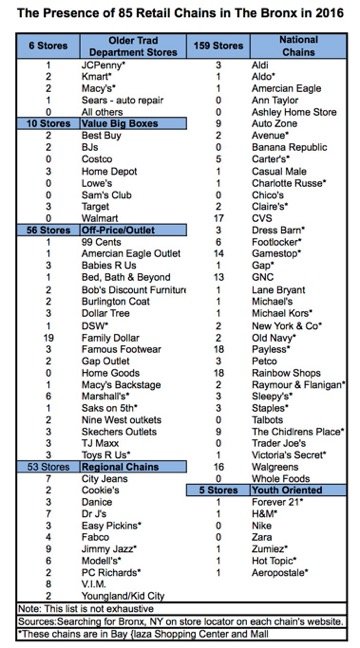
Lessons to learn From the Retail Growth in The Bronx. There are perhaps no better examples of poor ethnic inner city neighborhoods than those found in The Bronx, NY. It has 1.5 million residents, a population density of 32,903/SqMile, the lowest per capita income among NY’s 62 counties, and only about 10% of its population is white only. For decades, the fact that the entire borough was badly understored was widely acknowledged, and largely ignored by retailers and developers. However, in a slow, start and stop manner, retail has been growing in the borough since the opening of the powerful Bay Plaza Shopping Center in the mid 1987, with another burst in the early 2000s and considerable growth since the Great Recession. The table below lists the major shopping centers in the borough and provides some demographic information about them. Since around 2000, well over 3 million SF of new retail space has opened in The Bronx, with over 2 million SF since 2009.
Fordham
Road and The Hub are the two shopping districts with the physical
characteristics most like those of a downtown. They are also in the zip codes
with the greatest population densities and the lowest and third lowest
household incomes. Both have strong subway assets and Fordham Road has an
increasingly used Metro North station next to a large bus transfer point. Both
have comparatively little off street parking and are not that close to a major
highway. However, these two downtown-like districts have attracted a relatively
small portion of the new retail. The Hub
has seen little to no real growth. The 300+ store Fordham Road district has
done better. It remains a beehive of activity well after two major department
stores closed: Alexander’s and Sears. It has attracted a significant number of
national chains: American Eagle Outlet, Best Buy, Claire’s, Footlocker, GameStop,
Gap Outlet, Macy’s Backstage, Marshall’s, Nine West Outlet, Payless, Rainbow,
Sleepy’s, Staples, Starbucks, The Children’s Place, TJ Maxx, Walgreens and
Zale’s. Many of the larger chain tenants – Marshalls, TJ Maxx, Best Buy, and Macy’s
Backstage have gone into the buildings vacated by the department stores. Here,
as in Jamaica Center, large value and outlet retailers are important. There are few if any large retail prone
spaces of say 25,000+ SF available and that is probably constraining the
district’s ability to attract more major retailers.
Most
of the new comparison retail in the borough has gone into the other shopping
centers listed in the table. The characteristic they all share is that they are
car oriented: they sit next to major highways and have lots of off-street
parking.
They plainly are targeting shoppers who are located well beyond the
neighborhoods they are located in. For example, Target is an anchor tenant in three
of them and claims addressable trade area populations of 400,000+. The retailers entering into this paradigmatic
inner city county are showing by their stores how much they nevertheless still
favor self-contained car-oriented shopping centers over downtown-like
locations. To some degree, this may be because of the lack of appropriate
spaces in The Hub and along Fordham Road.
The
Bronx Terminal Market (BTM) is a 913,000 SF retail complex that opened in 2009,
despite the Great Recession, is perhaps the strongest example of the retailers
continued preference for strong highway access locations. It is owned and
operated by the Related Companies, one of the largest real estate
developers/owners in the USA. Its presence in the Bronx more than 10 years
ago certainly demonstrates that the interest of important retail developers and
retail chains in The Bronx is not new. The new Yankee Stadium also opened
in 2009. With the new stadium, political leaders and the Yankee organization
wanted the surrounding area improved. Metro-North put in a new station,
existing subway stations were improved and the BTM was built. Its tenant list
included: Babies R Us, Bed, Bath & Beyond, Best Buy, BJ’s, Burlington, GameStop,
Home Depot, Marshalls, Michael’s, Raymour & Flannigan, and Target. That’s
one powerful retail line up! Those retailers need to draw from a very wide and
densely populated trade area, one that probably goes well beyond the South
Bronx. The BTM’s location right next to I-87 allows such market penetration. Aside
from that asset, the BTM’s location is not a particularly desirable one for
retailers. It is located in a relatively
low-income zip code that has a population density that is far from the highest.
Its strong car orientation indicates
that while it certainly might draw some close by lower income shoppers, its
primary customer base will be middle income shoppers located along the I-87
driveshed.
The
Kingsbridge Broadway Corridor in Zip Code 10463 has attracted three shopping
centers that together total 530,000 SF. The first opened in 20004 and the other
two in 2014 and 2015. They too sit very near an I-87 exit. Their zip code’s
residents are solidly middle oncome and 24% of the households have annual
incomes of $100,000. This corridor is very interesting because retailers there
can tap the close-in Kingsbridge, Riverdale and Inwood neighborhoods. The three
shopping centers have definitely increased the retail choices of local
residents. The distances between these three shopping centers are certainly
walkable, but the way they are built and the setting along Broadway are not
conducive to making such walks. They are not downtown-like and have done little
to stimulate the creation of a walkable shopping district along this section of
Broadway.
The
300,000 SF Throggs Neck Shopping Center that opened in 2014 is in a similar
type of location. It is next to an exit on I-95 and the residents on its zip
code are solidly middle income, with about 23% of the households having annual
incomes of $100,000. The Targets in this and the River Plaza shopping center
both have their main sales areas underground, as does the Costco in Rego Park.
This was done to bypass the zoning aimed by city fathers at deterring the
opening of large big box stores.
The
New Horizons Shopping Center is a supermarket anchored center in a low-income
neighborhood. It was created through the hard work of a terrific neighborhood
organization, the Mid-Bronx Desperados (MBD), that worked with LISC. Today, it
has a Stop & Shop, Auto Zone, TJ Maxx, Footlocker, Petland, Game Stop,
Subway, IHOP and Taco Bell. This is a traditional suburban type, car oriented
shopping center, with shops located in a
sea of parking spaces. It is also very close to the Cross Bronx Expressway. It
is not an urban shopping project with a solid wall of shops on the ground floors of
buildings that abut and open to sidewalks. On the once infamous Charlotte
Street, MBD had previously built ranch style single family residential units.
Their occupants have well-tended backyards, some boats sitting in driveways and
some above-ground swimming pools. Given their MBD origins, both the housing and
the shopping center certainly reflected local aspirations and needs. Residents
in many other dense, low-income, ethnic urban areas may also aspire to more
suburban type retail projects. Because people are less affluent does not
necessarily mean they like downtown or other urban retail environments.
That may prove to be another challenge to inner city downtown retail growth.
The
Bay Plaza Shopping Center and Mall is an example of a large and growing
suburban mall, but one located in the middle one of the most densely populated,
highly “minority” and poor counties in the nation. It is isolated in the geographic arm
fold of two major highways, I-95 and the Hutchinson River Parkway, and only
accessible by car or, with some difficulty, bus. It plainly is targeting middle
income shoppers not only in The Bronx, but also in lower Westchester County. Opened
in 1987, it has grown to over 2 million SF, adding 780,000 SF in 2014. Its tenants
range from traditional department stores (e.g., Macy’s) and specialty retail
chains (e.g., Victoria’s Secret) to the value pricing department stores
(Marshall’s and Saks Off 5th) and retail chains (DSW). Also included
are several regional chains such as Easy Pickins and Jimmy Jazz. Importantly,
they have also attracted retailers who are big hits with teens and young
adults, such as H&M, Forever 21, and Hot Topic. The array of national
retailers in this mall far outshines what The Bronx’s closest approximation to
a downtown, Fordham Road, has to offer.
Back in 2016, I compiled a list of 85 national chains and researched how many had locations in The Bronx (13). See the table above. While the list certainly was not exhaustive, the results are hopefully still informative. I found 75 of the identified chains had Bronx locations and together they had a total of 290 stores.
As
might be expected, The Bronx still has not attracted. the likes of Gucci,
Prada, Valentino, Tiffany, Duxiana, Ralph Lauren, etc. They are far, far too
ritzy and more appropriate for Rodeo Drive in Beverly Hills, Midtown Manhattan
or the Americana Shopping Center in Manhasset, NY. Nor is The Bronx attracting,
perhaps thankfully, those like Talbots, Chico’s, Ann Taylor or Banana Republic
– many of these apparel chains still are fighting for survival. Trader Joe’s
and Whole Foods still have stayed away. So have Walmart and its sibling Sam’s
Club – due more to strong political opposition in NYC to Walmart than the
chain’s lack of interest in NYC locations.
The
retail chains that now seem to like the inner city Bronx’s markets the most are those:
Aiming at the lower income and
ethic shoppers: e.g., Family Dollar, Dollar Tree, Dr Jays, Jimmy Jazz, Rainbow
Shops, Vim and City Jeans. Many of them have been around for decades.
With a neighborhood level store
location strategy: e.g., GNC, Walgreens, Payless, GameStop, AutoZone and CVS.
These types of retailers have been locating in ethnic inner city districts
since the mid 1980s.
Targeting middle-income shoppers in either big box, off-price, or factory
outlet formats. Includes Home Depot,
BJs, Best Buy, Target, Burlington Coat, Marshall’s, TJ Maxx, DSW, Gap Outlet,
American Eagle Outlet, Macy’s Backstage, Nine West Outlet, Aldi, Saks Off 5th. These are more likely to have arrived after
2002, but some go back to 1987.
The retailers honed in on the middle class now operate in ways
that recognize its huge number of deliberate consumers who are:
Much more value conscious.
Cautious spenders.
Expect big price discounts from retailers.
SOME
TAKE AWAYS
1.
What national retail chains may do is largely irrelevant for a very large
number of our downtowns that are small. They either never had any chains or
only had a few non-GAFO chains. Their trade areas often are far too sparsely
populated – e.g., probably under 15,000 people –to support small GAFO retailers.
In these small downtowns, the abilities
of local merchants will be a more critical factor than the behaviors of
national retail chains.
2.
Most needed in these small towns are better merchants, through either
recruitment or re-training.
3.
That our inner cities are underserved by retailers has been recognized at least
since the early 1980s. This is not a new situation, nor is the awareness of it.
4.
National retail chains, probably since their inception, have been interested in
prime urban locations where lots of wealthy people lived and played, and they
have been prepared to pay a lot for them. Their locating today near to large new
market rate housing projects, especially if they are expensive, or in a walkable or TOD neighborhood, absolutely
comes as no surprise. What would be a surprise, is if they behaved otherwise.
5. For over 20 years, national retailers have been locating in highly ethnic inner city districts and downtowns, but the levels of their interest have been uneven over time and across places. The questions sparked by the Public Square article are: a) will retailers now locate in our inner cities at a higher rate than before, even though their demand for new retail space has significantly decreased, and b) will those stores be located in our inner city downtowns?
6.
The retail demand of low income shoppers in these inner city districts were
long met by local retailers, who often had lucrative businesses and created
chains targeted to low-income shoppers in similar districts.
7.
Middle income shoppers were the most underserved and complaining inner city
market segment. They were often surprisingly numerous and accounted for a large
proportion of an inner city area’s residential retail expenditure potentials.
8.
National chains that usually targeted middle income shoppers have over the past
20 years increasingly entered inner city districts, targeting, as might be
expected, local middle income shoppers. It is their presence and not the
density of the low-income shoppers that attracts these retailers.
9. The retailers best positioned to capture
middle income shoppers these days are those that feature strong value pricing in either big box,
off-price or factory outlet formats. These are precisely the types of retailers
that are entering densely populated inner city areas.
10.
Many of them require relatively large spaces and are accustomed to being in
very car oriented retail centers. They often are hard to fit into a downtown,
especially if it lacks large retail prone spaces and parking capacity. Consequently,
these retailers may prefer to locate in non-downtown inner city locations, and
downtowns might not benefit so much from any increased retail chain interest in
inner city locations.
11.
The use of smaller formats theoretically could enable more of these chains to
locate in downtowns, but their viability is still being tested and their placement
in ethnic inner city districts now is still uncertain.
12.
Most importantly, the retail industry remains in the midst of a process of
creative destruction that does not promise to end any time soon. As a result, how
much retail space will be needed in the future remains unknown, though it now
looks like it will be considerably less than it was even a few years ago. Also,
still to be clarified, are the uses the retail spaces will be put to, and how that will impact the amount of space needed,
their best locations and costs. These factors all have strong possible
implications for any downtown retail rebound.
13.
Many other factors, besides the interest of the retail chains will determine
how a downtown’s retail will rebound. Among them are: the abilities and
behaviors of retail chains’ managers and local landlords; political, urban
design and environmental issues, the availability of appropriate retail-prone
spaces and ample parking, and, most importantly, where and how local consumers
like to shop.
14.
There are some other interesting types of downtowns that appear to have their own
retail development scenarios these days: downtown creative districts; the lifestyle
mall suburban downtown; the urbanized suburban downtown; the rural regional
commercial center downtowns, and the small rural downtown gems. Unfortunately,
I cannot cover them in this already long article, but I want to acknowledge
their existence.
Part 2of the A Closer Look at Some Strategic Challenges Generated by the New Normal for Our Downtowns Series of Articles
By N. David Milder
Introduction.
There are a number of issues that involve questions about who will visit, live, work and play in our downtowns and how all stakeholders – be they those who live, work and play there or those who own properties and businesses – can share in their successes. The term “equity” seems to fit all of these issues. Their emergence has been relatively recent, and their full dimensions are probably yet to be grasped. As a result, most are not on the radar screens of many downtown leaders, save in those cities where the problems have already become very acute and/or nationally visible, e.g., affordable housing in San Francisco and the entire Bay region.
The core equity issues are essentially about what our values and preferences are and how they will be applied to many of the component parts of these successful downtowns. Decades ago, at their nadir, downtowns had a different set of users and, often, different stakeholders. Strong concerns about equity were not really salient since there were so few goodies to distribute and so few people who wanted either a psychological or legal stake in these districts. These days, that has all changed. The equity issues are generated by downtown and community successes, sometimes huge ones, not their failures!
Way back when, it may have been from one of Jane Jacobs’s books, I learned two axioms about downtowns that have stayed with me ever since:
A downtown needs its community’s residents to take psychological ownership of it. It must become “my downtown” in their guts. When that happens, they will not only use it, but also politically defend it, and support efforts to improve it. Psychologically, they become stakeholders.
A downtown should be everyone’s place. It should have attractions suitable for large swathes of the community. It also should be the community’s central gathering place. Anyone acting in an orderly manner should be welcome.
During the decades when downtowns were in decline, it seemed as if few people within their communities wanted to take psychological possession of them. Today’s successful downtowns show a marked ability to attract many more people, many of whom are affluent and well-educated, to live, work and play in them. In some, where the median price of a residential unit exceeds $1m and where the price of a ticket to a show or ballgame can exceed $1,000 in secondary markets, many local residents may wonder what’s there in the downtown for them?
Who Can Afford to Live Downtown?
Downtown experts agree that more residents in the downtown and in neighborhoods within reasonable walking distances of it have been the strongest engine for downtown revitalization. Yet, more housing in those places is proving to be a double-edged sword and concerns about middle income and “workforce housing” are popping up across the nation. The situation in San Francisco has attracted a lot of national attention and demonstrates many aspects of this problem. Nearby Silicon Valley has had a famed economic success and many of its relatively well-paid workers seek housing in San Francisco. For example, Google-owned buses haul hordes of them to and fro daily. The result has been a very expensive housing market in the entire Bay area. It’s become very difficult for these relatively affluent workers to find affordable housing and those pressures are also impacting other types of workers. One response is to accept smaller and/or unusual types of dwellings. Here’s a recent headline in the New York Times: “Dorm Living for Professionals Comes to San Francisco” (1). The article goes on to detail that: “In search of reasonable rent, the middle-class backbone of San Francisco — maître d’s, teachers, bookstore managers, lounge musicians, copywriters and merchandise planners — are engaging in an unusual experiment in communal living: They are moving into dorms.”
Dorms and other “co-living” arrangements are just one solution path San Franciscans have followed to cope with their region’s skyrocketing housing costs. For example, Business Insider even headlined that: “A 23-year-old Google employee lives in a truck in the company’s parking lot and saves 90% of his income” (2).
A Cargo Container Converted into a Small House in San Franciso.
The Tiny House movement has even penetrated the San Francisco area as evidenced by the photo above taken from an article in Business Insider (3). In this instance, a cargo shipping container was converted into the wee home. Some more affluent San Franciscans have spent $1m+ to purchase and renovate “earthquake shacks,” or are living on boats in the bay. Still others are squeezing together with a large number of roommates into an apartment or house (4).
High housing costs are not confined to San Francisco. As can be seen in the above table, in all 10 of these highly successful major cities, the ratio of median home prices to median household incomes exceed the 5.1 level deemed to indicate serious unaffordability.
An important question: are the housing costs in smaller communities than our major cities also skyrocketing and having adverse impacts? Probably yes, if they are located in a region, such as the San Francisco Bay Area, where the whole area is thriving economically. For example, the communities where the Jobs, Zuckerbergs, Pages, and Ellisons live are small and hyper expensive. In less economically robust regions, one might expect a more complicated picture. My hypothesis is that higher housing prices are an inevitable result of a downtown and its community becoming successful, desirable places to live, work and play. So, where that has happened, the prices will very likely be higher. For instance, in districts that have recently experienced a significant revitalization that was propelled by mix-use, residential anchored projects. This has happened in a number of suburban communities around our major cities, especially those served by commuter rail. Otherwise, in smaller towns and cities, housing prices probably have not skyrocketed. For some smaller towns, their lower housing costs when combined with strong quality-of-life assets, and decent broadband and transportation access, might give them a meaningful competitive edge in attracting new residents and businesses.
“Micro-living,” i.e. living in units of 300 to 400 SF or less is a growing phenomenon in cities across the globe where their economic success has pushed housing prices well beyond what middle-income and even upper-middle-income persons/households can afford. In the U.S. they can be found in many of our largest cities — e.g., Boston, Chicago, and NYC – but especially in cities such as Atlanta, Cincinnati, Denver, Pittsburgh, Seattle, St. Louis and Washington D.C., where the share of single person households exceeds 40%. The mini apartments also are not unusual in Tokyo and many European cities (5).
To provide some perspective on these 300 SF to 400 SF units, consider that in the recent past many of their occupants would have rented studio apartments. Their average size in NYC, San Francisco, and Oakland are 550, SF 514 SF and 531 SF respectively. The micro-living units are 20%+ to 40%+ smaller than the studios. Also, consider that in the 20 most populous metro areas there is a distinct trend toward smaller units – though all still average above 854 SF (see the above table). The decreases in size have been smallest is in the metro area that have very high costs and low costs and highest in the high cost and moderate cost markets.
The small units, such as those in dorm or co-living buildings, often have desirable social/communal advantages that attract their inhabitants. Whether a true equity issue exists for these residents under these conditions depends on whether the inhabitants really want to live in such units or are occupying them because they are the best of the bad options available to them.
This discussion would also be more informed if there was some research establishing that humans need abodes that have XYZ square feet of living space. My memory says that HUD somewhere at some time established that dwellings were overcrowded if a unit’s occupants have less than 188 SF each. I have not found any research that supports a number like that. Moreover, it is highly probable that the personal space needs vary culturally. For example, NYC subways certainly get crowded, but I doubt that their riders would accpt either the level of crowdedness found in the Tokyo subways or their use of car packers to assure that the subway cars are maximally stuffed with riders. Moreover, there are many people in neighborhoods in the Borough of Queens in NYC, such Kew Gardens, Forest Hills, Bayside, who use the l far more expensive Long Island Rail Road rather than experiencing the crowded subways.
Many San Franciscans and residents of other high price communities have responded to the housing equity issue with their feet. A recent report notes that: “San Francisco lost more residents than any other city in the US in the last quarter of 2017…. San Francisco lost net 15,489 residents; about 24% more than the next-highest loser on the list, New York City” (6). This behavior pattern probably results in area firms losing a lot of talented employees. Of course, very high housing prices probably will also dissuade a significant number of talented people from taking jobs located in a community.
Tourists and Tight Housing Markets. City leaders, their economic development officials and local business operators often brag about how many tourists and second homeowners they have and all the revenues and jobs that means for their local economies. However, the residents of many of these communities may tell a different story. They may note that the retail developed for tourist shoppers really does not provide the types of merchandise and services they need or want and often creates seasonal traffic nightmares on local streets. In many communities, large and small, tourists also have impacted negatively on the housing market from the perspective of the needs of local residents.
Moses Gates, in a study by Regional Plan Association (RPA), noted that: “54,764 apartments in New York City … are vacant, according to the 2014 Housing and Vacancy Survey – but not really. These are apartments used for ‘seasonal, occasional, or recreational use’ – i.e., pieds-à-terre or second homes” (7). He went on to state that:
“We also need to better leverage our housing inventory, especially in places where land is scarce and building new homes is difficult. One way to do that is through policies like a tax surcharge on second homes in the New York City (or a pied-à-terre tax) designed to get mostly unused apartments back on the housing market.”
It should also be noted that strong suspicions have been raised about many of these pieds-à-terre in some of our biggest and most tourist-popular cities (e.g., NYC, Miami, etc.) being money-laundering operations for their wealthy and unknown foreign owners.
Many of these units are vacant for most of the year. They thus do not contribute the pedestrian traffic to the sidewalks below nor the expenditures in the city’s shops, restaurants and entertainment venues that one might reasonably expect – nor the sales taxes on those expenditures.
Are these second homeowners to be treated differently from a downtown’s normal stakeholders? Laws probably protect them in many ways, but I am certain that many local residents would say there is something unjust stirring here that must be fixed.
Airbnb has seemed to be looking for trouble in a host of cities, quickly getting into conflict with city governments because of its alleged flaunting of local laws and putative negative impacts on the availability of affordable housing. As a recent study published in the APA Journal noted, Airbnb had been criticized for enabling:
“…tourism accommodations to penetrate residential neighborhoods, which creates conflicts between visitors and residents, displacing permanent accommodations in high-demand cities and exacerbating affordability pressures for low-income groups (8).
Governments, at all levels, have for decades often mounted programs to cope with the affordable housing issue, though they almost always targeted low-income and impoverished households. Also, the units produced by those programs usually were placed in poor neighborhoods or in those very out of the way, e.g. Far Rockaway here in NYC. The downtown housing equity issue differs in that the targeted population is middle or even upper-middle-income households and that the units produced for them should be at least within a very reasonable travel time of the downtown. It would also probably be a good idea to have representatives of these residents and their employers extensively involved in the development of the needed housing units.
Downtown Success Encourages Landlords to Ask Independent Retailers for Unaffordable Rents
This problem is made more complicated by the fact that to properly understand it one must break it down analytically into three constituent parts: fairness to the merchants, impacts on vacancies, and the impacts of the loss of popular, able merchants. In many discussions of the affordable retail rent problem, things get murky as attention quickly shifts from one of these sub-issues to another. My objective here is not to provide definitive solutions, but to help illuminate the problem and to suggest some solution paths that may be worth exploring.
The Problem Is Not New. Unaffordable retail rents are an issue that long predates the Great Recession. For example, back in the late 1970s, when I surveyed street-level merchants in Charlotte’s CBD about how they were impacted by an off-street, internal shopping network that was created by overstreet bridges connecting a number of new buildings, they replied that it took traffic from the sidewalks and led to hard to afford rent increases. In the two districts I managed, I never met a small merchant who did not have something negative to say about their rent increases.
Generally, when downtowns or neighborhoods become observably successful, they not only attract retail chains, but also tend to attract many other types of businesses, such as personal, professional and financial service operations. A very high percentage of these operations can afford higher retail rents than the average independent retailer. Some, such as the banks, are willing and able to spend a lot more on rents than even the well-heeled retail chains. As one observer noted: “Banks frequently overpay by 15% to 20% or more on average for real estate compared to other retailers for comparable space. Over 10 or 20 years we’re talking a lot of money!” (9).
I put together the above table for an article I wrote back in 2010. It shows how much space a merchant could afford to lease if 15% of his or her annual sales were devoted to paying rent (10). The 15% figure makes the analysis somewhat conservative, as a more accurate number would the 8% to 12% range for downtown merchants and about 10% for restaurants. Small merchants just cannot afford a whole lot of space in any successful district unless they have very significant annual sales.
Small retailers have not been the only group impacted on. Jeremiah Moss, in his book Vanishing New York, describes how bohemian artistic live-work areas, such as the East Village, were erased by major retail chains coming in.
Why Do Landlords Ask for Unreasonable Rents? Landlords are not necessarily being venal or thoughtless if they sign these higher paying tenants when they appear on their doorsteps. They are simply responding rationally to proven market demand. Of course, even then, they must decide, perhaps just implicitly, that these non-retail uses will ultimately generate more value than if a current small retail tenant was retained. However, one might ask if they considered how that tenant might affect nearby businesses and buildings or if they just considered their own bottom lines. Obviously, another important question is if considering the impacts of a potential tenant on the district should be obligatory in some way, shape or form? This problem would ease if a landlord or an accomplished EDO owned a lot of downtown properties with retail tenants and managed them like a mall, but that is an unlikely outcome.
Here are some other patterns that I have found in the ways landlords establish their rent increases
Some increases are based on a reasonably accurate assessment of local rising property values and dominant asking rents. Both of these may already reflect the district’s growing success. These landlords tend to avoid asking for the highest rents. Among them, are a number of experienced professionals who see the landlord function as having strong stewardship aspects and consider what is good not only for their properties but also for those that are near them. I fear that they are a dying breed. How instead can we develop more of them?
Some small landlords I’ve spoken to simply could not explain the reasons for their very high rent increases, save to say they were products of their best judgments. Among those that I have met, many were new to the U.S. and new to local property and retail markets. A number of them would stubbornly maintain unreasonable asking rents for a year or more. These landlords do not typically care who their tenant is as long as they pay the asked for rent. Here the high rents and vacancies are being sustained by landlord ignorance and management ineptitude. Newness to the area is another factor.
Other increases are based on hopes, often wishful, that a national chain or other higher paying tenants can be attracted that will pay much higher rents and have a better credit rating than those of the current independent retail tenant. An analysis of the local retail market is either perfunctorily done or simply missing. An example of this is Wong Kee, located in Manhattan’s Chinatown. It recently “succumbed to a new landlord and rising rents.” It was in Chinatown for nearly 30 years. Its lease was not renewed. by the landlord. The landlord wants to build a pharmacy in its place, though there are already several pharmacies nearby (11). This type of landlord needs to learn what is really feasible from a business recruitment perspective.
A few other landlords – usually those unfamiliar with the downtown, retailing or even property ownership – will ask for very large increases because they paid way too much for their newly purchased building. Their huge rent increases are what they need to financially stay whole. This may be because their bank loan agreement probably stipulated a formula for determining what the rents should be. There was little room for them to consider local market factors, even if they wanted to — and too many didn’t care anyway. According to Jerimiah Moss, banks will devalue a property if it has a small business tenant but increase it for a retail chain tenant. “There’s benefit to waiting for chain stores. If you are a hedge fund manager running a portfolio you leave it empty and take a write-off” (12). In other words, such landlords have tax incentives that encourage them to demand very high rents and tolerate long-term vacancies. They also seem absolutely oblivious about how a vibrant district will increase their local property values and bottom lines.
The Fairness Issue. Local residents and civic leaders may feel that some of the merchants facing unaffordable rent increases are being unfairly treated. This issue is implicitly present in most usages of the phrase “unaffordable rents” where unaffordable is really seen as a synonym for unfair. Should such an equivalence be accepted? Moreover, why should any government entity or nonprofit help those facing unaffordable rents? Market forces are freely at work and, to quote Barzini in the Godfather, “After all, we are not a bunch of communists.” I would argue that it is not the unfairness of the unaffordable rents that justifies remedial action, but their most important impacts: long-term and multiple vacancies and the loss of many popular, high-quality merchants.
Vacancies. First, let’s establish that a certain level of vacancies is necessary for a downtown to work correctly and prevent ossification. Downtowns need some churn to recruit new, attractive merchants and to get rid of the dregs. I think it’s generally accepted that a vacancy rate below 5% suppresses the desired level of churn while one above around 10% can have bad effects on the district. Many consultants, downtown leaders and, perhaps more frequently, elected officials, believe that vacancies can be an unattractive creeping plague. However, the real problem about vacancies may not be the emptiness of the storefront, but the absence of an accomplish operator to occupy it. Let me anticipate those who will claim that a cluster of empty storefronts is visually an eyesore for the district, diminishes its walkability and a puts a blemish on its reputation, by asking: Is the district really any better when the vacancies are filled by unpopular, inept operations? Bad operators can repel customers and downtown visitors even more than empty storefronts.
It is also important to realize that any valid explanation of today’s retail vacancies must take a multi-causal approach that includes far more cautious consumer behavior, the rise of Millennials who prefer experiences over things, significantly reduced demand by retail chains in terms of both the number and size of their new locations, and affordable rents. The reduced retail demand is especially relevant because many of the landlords that were pushing out independents were doing so in hopes of recruiting the very chains that were hardest hit by reduced consumer favor and demand, such as the apparel specialty retailers.
It is also important to consider that reducing landlord asking rents is not the only way of reducing vacancies. As Andy Manshel reminded me, good results can be achieved by “animating vacant storefronts with temporary art or high-quality other pop up uses.” He also suggested that vacancies could be taxed, motivating landlords to sign leases.
Generally, it can be reasonably argued that concern about vacancies is a misunderstanding of the essential core problem.
The Loss of Popular, High-Quality Merchants. That core problem is not the emptiness of the vacancies, but that ill-informed landlord rent increases can result in the closings of independent merchants who are well-loved in the community. They are real losses for their customers, nearby business owners, and their district. Additionally, it usually is very hard to replace them.
However, it must be understood, that by definition, about half of a downtown’s merchants will be below average in their performance, including their ability to satisfy local customers. Are the potential closings of poorly performing, unpopular merchants the type of losses that are worthy of preventive actions by an EDO or municipal interventions? Some, who are ideologically committed to small businesses, may say yes, believing every small firm by definition is worth retaining or saving. Yet, many savvy downtown managers and civic leaders see a prime result of their revitalization efforts being the replacement of their poor-quality merchants, not necessarily with bigger operators or chains, but with higher quality operations.
Who Should Receive Help? One might cogently argue that the harm done to the public and/or district that would result from the closing of a popular and able merchant might justify an EDO or municipal intervention, but how much sway should the “fairness” of the rent increase have? For example, should an unpopular or incompetent merchant who gets an unaffordable rent increase be helped? That would imply that the fairness issue carries the day. Or will assistance only go to merchants who are able and/or popular? Is the fairness issue unrelated to the issue of the merchant’s value to the community or district? I would suggest that the fairness issue only becomes relevant when the merchant’s community value criterion is satisfied.
My observations suggest that the merchant’s value to the community is very likely to be considered when one specific business favored by an important segment of the community announces that it will soon need to move or close – whatever the cause, e.g., poor sales, increased competition, workforce problems, high operating costs (including costs of space) etc. In contrast, because of the sheer number of businesses involved, municipal attempts to remediate unaffordable rents cannot logistically evaluate each of the benefiting firms and it would probably be a political nightmare to do so anyway. As a result, the fairness issue seems to prevail when municipal actions are taken. For example, here in NYC, the City Council has passed a bill that reduces the Commercial Rent Tax that businesses have to pay if they are located in Manhattan below 96th Street, pay $250,000+ annually in rent, and that have annual revenues under $5m (13).
In several large cities across the nation — NYC being one of them — proposals also have appeared for rent control laws that cover properties with retail uses.
What Kind of Programs Do We Need to Cope with the Unaffordable Rents Problem? Municipal actions tend to treat quality merchants and underachievers in the same way, probably out of necessity. Moreover, both the retail rent control and merchant tax abatements seem to be rather shotgun approaches aimed at helping broad classes of small merchants. The key actors, whose behaviors need to be altered, are the landlords, not the merchants. The retail rent control approach carries with it great potential dangers and certain resistance from the entire real estate community. Yes, the tax abatement helps some worthy merchants, but it also helps make the unaffordable rent increases more bearable. In that way, it implies the increases are justified.
Downtown EDOs may be in a far better position to mount more effective programs to influence landlord behavior. Many of the landlords are probably on their boards and many others have engaged in their programs. Anyone who wants to educate or convince landlords has to have won their esteem, trust, and confidence. The goal of such an educational effort cannot unrealistically be to convince large numbers of landlords. Instead, it should be, to convince a savvy few among them who can lead by example and thereby also exert some market pressures for others to follow.
Probably the best solution to the affordable retail rents problem is to help able merchants buy the spaces they need to do business. They might do this alone or as a group. Buying a single storefront space is unlikely unless it is from some kind of retail coop or condo. In many suburban towns and cities with populations under around 100,000, I’ve encountered retailers who own the entire buildings in which their stores are located. In big, high rent districts with stores located in big expensive buildings that is not likely
It might be possible for buildings that have multiple storefronts to lease, that a partnership of some kind might buy either the entire building if it is cheap enough or just the retail spaces in the larger more expensive buildings. These groups of retailer property buyers most likely will not emerge organically from the merchants themselves. Probably, they will need the catalytic interventions of teams lead by the downtown EDO that has strong active support from the municipal government and a civic-minded developer.
Local governments can do a lot to assist the development of the retailer-owned co-op or condo buildings:
Provide low-cost land or a low-cost building.
PILOTS just as developers are ordinarily given.
Other abatements such as on NYC Commercial Rent Taxes.
The EDO might also help the buyers connect to financial organizations that will provide them with loans that have reasonable terms.
If helping able retailers purchase their spaces is not viable, here are some other actions that might be tried to assist these merchants. Their effectiveness is far from assured. To influence landlords, local governments might consider:
Using zoning and tax incentives to reduce spaces so that they are smaller than what chain stores would want, perhaps around 1,500 SF to 2,000 SF. Landlord blowback can be expected. Also, quality independent merchants might find such spaces too small and a few chains now might still find them suitable.
Use zoning to limit where chain stores can go. This has been done for personal service operations and big boxes. Various legal and political problems can be expected. Landlord blowback can be expected.
Use their own legislative powers to change its tax code to erase any incentives for landlords to demand higher rents and tolerate long vacancies. Also, vacancies might be taxed as if they were occupied.
Use their external political influence to change the state’s tax code to erase any incentives for landlords to demand higher rents and tolerate long vacancies
If the retailer space purchasing option is not viable, to influence landlords, downtown EDOs might consider:
Creating either a formula that landlords can use to calculate an appropriate affordable rent for their retail spaces or to identify the steps in an analytical process that can help landlords make a well-reasoned decision about rent increases.
Educating landlords about the importance of taking into consideration district benefits and harms in their recruitment decisions.
Make a special effort that targets landlords new to the district, retailing or property ownership.
Jawbone banks about the value of small merchants to properties and downtown.
Issue a brief annual report that identifies the most “recruitable” types of businesses to the district and the types of spaces they will want.
Publicly praise and disseminate information about what landlords who are effectively dealing with the rent increase issue are doing.
To help high value, threatened merchants, downtown EDOs should assist them to:
Find new locations. Deft use of the Internet can help many independent retailers thrive in locations previously deemed less than optimum.
Find financing for the move.
Publicize their new location to let current and potential customers know where they now are.
Who Can Play Downtown?
As Central Social District (CSD) functions and venues have become of growing importance to the vibrancy and success of our downtowns, this basic question has become correspondingly important.
A few years ago, I put together the above table to demonstrate the user frictions that five specific CSD venues and two types of CSD venues have here in NYC. The specific venues were Bryant Park, Lincoln Center (LCPA), Madison Square Garden (MSG), The Museum of Modern Art, and The Metropolitan Museum of Art. The types of venues were movie theaters and Broadway theaters. The user frictions I looked at were:
When the venues were open.
Their admission fees.
Whether the user’s schedule could drive a visit or does the user have to conform to what is available on the venue’s schedule of performances.
Can the venue be used for visits that last 45 minutes or less? Lots of downtown visitors have holes in their schedules of that length and districts that have venues that can entertainingly plug those holes will be much stronger than those that cannot.
From the perspective of when the venues are open for people to use them, hands down Bryant Park has the most hours open, followed by the movie theaters. LCPA and MSG are basically closed during most days, while the two museums are closed 5 nights a week. If you work or go to school, these results mean that some venues are much harder to use than others.
Another key friction is how much it costs to be admitted to these venues and here is where many downtown users are simply priced out. Again, Bryant Park followed by movie theaters are the most affordable – and in many instances by gargantuan amounts of dollars:
Bryant Park is free to enter and the fees for using some of its attractions, such as riding the carousel or ice skating, are reasonable. It and other parks in the city cost the least to use.
At the time I did the research, my check of cinemas in Manhattan showed the average price for a ticket was about $13. Nationally, at the time it was about $8. I would argue that movie house ticket prices should be the benchmark of affordability because so many people still go to the movies.
MoMA and the Metropolitan Museum of Art rank next in lowest general admission prices. The Met “asks” for a $25 donation; MoMA requires it. The Met request is based on the deal the city made when giving land for the museum that gives NYC residents free admission. Residents can pay what they want or nothing at all. A $25 fee/donation to these museums would be 1.9 times more than the average cost of a movie ticket in Manhattan.
The prices at Lincoln Center are pricey. An average ticket to the opera costs $156. That’s 12 times more than going to a movie and taking a four-member family could cost a real bundle. If you want to accept alpine, nose-bleed seats you can get a ticket to a NY Philharmonic concert for about $29. But prices go up to about $112/concert if you are a subscriber to a series. That’s 8.6 times more than a movie ticket. Tickets to the opera and philharmonic concerts can be even higher than those cited if they are purchased on the secondary market and there is strong demand for them. But, given that their audiences have weakened in recent years, the markups are not as large as for Broadway shows or Madison Square Garden events. Perhaps in recognition of its high admission prices as well as its mission to serve a broad public, the Philharmonic does give a lot of free concerts on the LCPA’s campus as well as in the boroughs outside Manhattan. It also has a significant educational program in NYC’s schools.
In 2013, the average price for a ticket to a Broadway show was $98.64. Back in 1955, for her birthday, I took my girlfriend to see Mr. Wonderful on Broadway. We had dinner before at a steakhouse, Gallagher’s and to get to and from I hired a limo. It was a very memorable evening. The whole thing cost under $70, with the fifth-row center seats costing about $8.50 each. Adjusting for inflation, the price of those tickets would be $73.91 in 2013 dollars, substantially less than the actual $98.64. The difference is probably substantially accounted for by higher costs, such as for labor, talent, marketing, and equipment, etc. The biggest problems with today’s Broadway theater ticket prices is that so many of the tickets are bought by dealers who then resell them at substantial markups and that some hot plays are asking for $500 a ticket. Paying $1,000+ per ticket for hot shows.in the secondary market is far from uncommon.
The average ticket to a Knicks game at Madison Square Garden, in 2013, cost $125, while a ticket to a Rangers was $78. A ticket to a Billy Joel concert at the Garden could range from from $64 to $124. However, here too, a significant percentage of the tickets are captured by dealers in the secondary market and prices for a very popular game or concert can go above $1,000. Joe Six-Pack fans are unlikely to have the financial resources to attend with any regularity the basketball and hockey games of their favorite teams. Their attendance is more likely confined to special occasions for which they either plan early and save or are gifted. For these fans, downtown sports bars may be one way to deliver the more affordable TV access to these games in an arena-like, fan-filled setting.
Parks, other public spaces, and movie theaters are entertainment venues that help make a downtown everyone’s neighborhood. They are the most easily accessible and the least expensive to visit. Consequently, they provide reasons for most of a community’s population to take psychological possession of their downtown. Where they are absent or weak, the downtown will be lacking very important support mechanisms. On the other hand, attendance at the events of many high culture performing arts venues, popular concerts, and professional sports events can only be afforded by those with above-average amounts of discretionary dollars to spend. These folks, too, are assets for their downtowns, assets that downtown leaders only dreamed of attracting in years past.
The Impact of Tourism. The table above was generated from data published online by the Broadway League. It shows just how much the attendance at Broadway shows is dominated by out-of-towners. Just 22% of the ticket holders are NYC residents. Another 18% come from the surrounding suburbs. Most, 61%, are tourists, with about 46% coming from other parts of the USA and about 15% from other countries.
Strong tourism can have important impacts on a local economy. For example, here in NYC, we have about 60 million tourist visitors annually and their direct spending in 2016 amounted to about $64.8 billion (14). About 6.45 billion went to firms in the recreation and entertainment industries. Without tourist expenditures for Broadway tickets, the relatively high ticket prices probably would not have been reached or maintained. One may wonder if a lower flow of tourists would have resulted in lower Broadway theater ticket prices that would have attracted more buyers from NYC residents and from folks in the surrounding suburbs.
As is happening in many entertainment niches (defined to include cultural/arts venues) across the nation, tourism now accounts for very high percentages of the attendance at many of NYC’s major entertainment venues. This is particularly true for our most prestigious museums, where tourists account for 75% or more of their attendance (see table above). These institutions aspire to be and are world-class venues. That means that though they are located in NYC, for New Yorkers, they are no longer just theirs. Some psychological adjustments may be needed. As I write this I remember many years ago, when my neighbors and shopkeepers in Paris warned me in the late spring, that soon “your Americans and the Germans would come” and Paris would not be the same until the fall. They were absolutely right. The buildings, the Seine, the Metro, the museums were all the same, but Paris in the summer was very different. My French friends explained that they felt during the summertime as if their beloved city is taken over by foreigners. It’s really not theirs during those months. Things may have changed in Paris since my student days there, but that sense of tourists taking over is one I’ve encountered in several other communities here in the USA
Tourism can be boon for many downtowns, but it also often is a two-edged sword, that brings a number of problems with it. Some of these problems are obvious, such as how tourism can impact housing and retail, while others may be quite subtle, such as residents psychologically feeling dispossessed in their own communities. Part of the New Normal, as more and more downtowns become adept at attracting tourists, will also be the emergence of these problems.
13. Sarah Maslin Nir. “Tax Break Could Help Small Shops Survive Manhattan’s Rising Rents.” New York Times. Nov. 28, 2017. https://www.nytimes.com/2017/11/28/nyregion/rent-tax-manhattan-local-shops.html
14. Tourism Economics. “The Economic Impact of Tourism in New York.” https://www.governor.ny.gov/sites/governor.ny.gov/files/atoms/files/NYS_Tourism_Impact_2016.pdf